


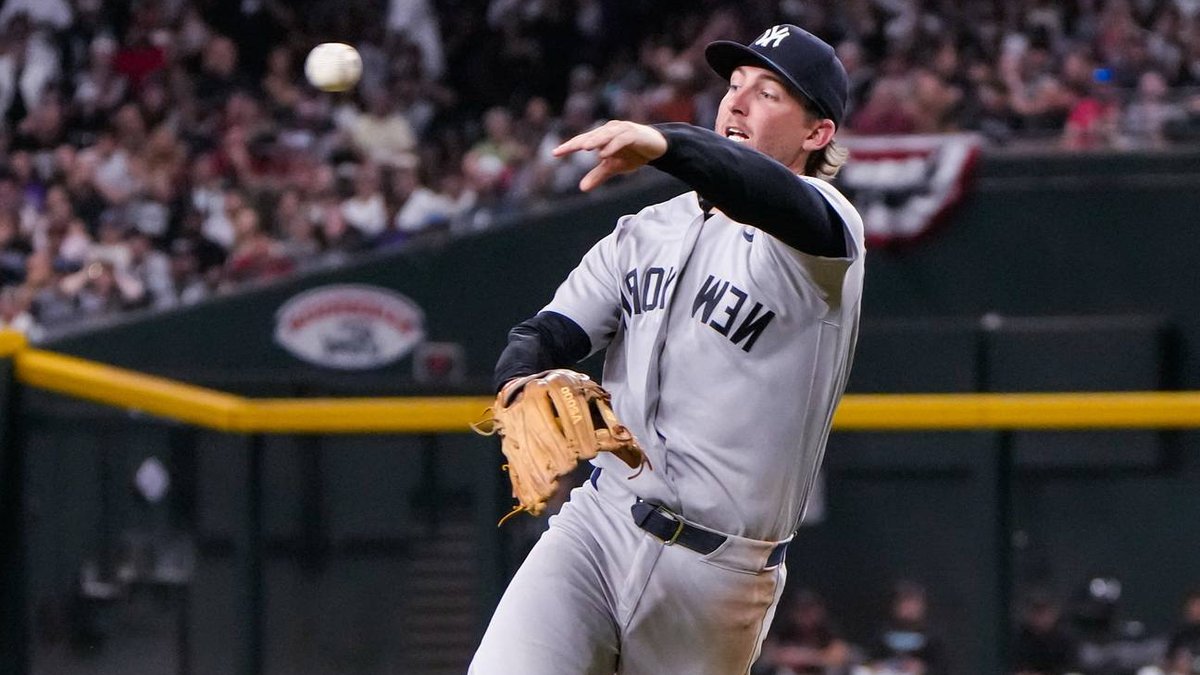
The Yankees’ defense unraveled spectacularly during Game 2 of the ALDS against the Rays, leaving fans and analysts baffled by the sheer volume of mistakes. Tampa Bay’s aggressive, contact-driven approach forced New York into repeated errors, but the scale of the collapse went beyond a single rough night. The team recorded three errors in the first inning alone—a postseason record—and failed to stop the Rays’ offense for much of the contest.
Chandler Simpson’s ground ball to third base was botched by Ryan McMahon, while Jazz Chisholm Jr. failed to turn a double play, throwing wildly to first and allowing Yandy Diaz to score. The inning’s final error came when Cam Schlittler’s strikeout was erased by catcher’s interference from Austin Wells, who blocked Liam Hicks’ swing with two strikes already on him. Even a potential fourth miscue, Chisholm’s shaky throw to second, was saved only by George Lombard Jr.’s quick recovery.
No Yankees team in postseason history had ever committed three errors in a single inning before Monday’s game. The last time any team managed that in the first inning of a postseason contest was the 1909 Tigers, over a century earlier. The Rays seized the advantage, scoring early and extending their lead in the fifth when Chisholm ignored an infield-in signal, leaving himself no time to throw out Jonathan Aranda at home. Lombard later mishandled a ground ball, though it was later ruled a fielder’s choice, while Luis Garcia Jr. dropped an errant throw, allowing Johnny DeLuca to reach first and eventually score.
Read Also: Fantasy Football Week 5: Top Flex Players and Waiver Targets
Yankees’ offense fails to answer
The Yankees’ offense showed similarly little improvement. After being held scoreless in Game 1, New York managed just four hits in Game 2, with Ben Rice’s two solo home runs accounting for their only two runs. The absence of Aaron Judge left the lineup struggling.
The Rays had made it clear they would not lose close games. Max Fried, the Yankees’ starting pitcher, had acknowledged before the series that Tampa Bay’s strengths, speed, contact, and execution, meant New York could not afford mistakes. “They’re not going to beat themselves,” he said. “You have to go out there and beat them.” Instead, the Yankees’ sloppy defense handed the Rays the game.
Pattern of postseason defensive collapses
The Yankees’ struggles in Game 2 echoed their collapse in Game 5 of the 2024 World Series, when a five-run meltdown against the Dodgers exposed the same defensive weaknesses. That outing included two costly errors and Gerrit Cole’s failure to cover first base on a grounder, reinforcing New York’s long-standing issues. Nearly two years later, the Rays exploited those same flaws with surgical precision, turning the Yankees’ infield into a liability. Scouting reports from the Dodgers had already flagged the team’s defensive inconsistencies, and Tampa Bay’s approach, speed, contact, and relentless execution, simply magnified what had long been a known problem.
Read Also: Royce Keys faction emerges as WWE’s biggest Bloodline threat
The Rays’ ability to capitalize on the Yankees’ mistakes was no accident. They had faced New York 13 times during the regular season, winning six of those matchups, and knew exactly how to neutralize the Bronx Bombers’ strengths. Their postseason strategy remained consistent: force errors by making contact, moving runners, and punishing hesitation. The result was a game where Tampa Bay’s fundamentals overwhelmed New York’s lack of discipline. Even when the Yankees avoided an error, such as Lombard’s recovery on Chisholm’s shaky throw, the damage had already been done. The Rays’ patience and precision turned routine plays into scoring chances, leaving the Yankees’ infield scrambling against a team built to thrive on chaos.
Schlittler’s outing worsens Yankees’ struggles
Cam Schlittler’s performance on the mound did little to offset the defensive collapse. In his first-ever road postseason start, he lasted just 4 1/3 innings, surrendering six hits, four runs (two earned), and one walk while striking out only two batters. His inability to generate strikeouts, especially against a Rays lineup designed for contact, further exposed the Yankees’ lack of depth in their rotation. Schlittler’s exit came as the Rays extended their lead to 5–1, a score that reflected both the offense’s efficiency and the defense’s inability to support the pitching staff.
With Game 3 now the deciding factor, the Yankees’ ability to correct their defensive lapses will determine the series’ outcome. Max Fried, set to pitch again, will need more than just a strong outing; he’ll need a defense that executes the basics. The Rays have already proven they do not lose tight games, and the Yankees’ history suggests they will not beat themselves. The question remains whether New York can finally address the defensive issues that have plagued them for years, or if the 2026 postseason will be another chapter in their struggle to master the fundamentals.


